
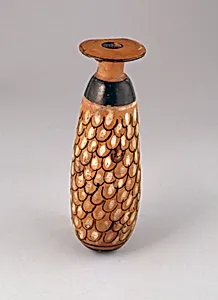
Alabastron
early 4th century BCE
Medium
Terracotta
Dimensions
Diameter: 1 1/4 × 1 1/8 in. (3.2 × 2.9 cm) Height: 4 1/16 in. (10.3 cm)
Classification
Vases
Culture & Period
Greek, Attic · Late Classical
Department
Greek and Roman Art
Museum
Metropolitan Museum of Art, New York, NY
Credit
Rogers Fund, 1906
Accession Number
06.1021.89
Rights
Public Domain
Art Historical Context
This delicate terracotta alabastron, attributed to the Bulas Group and dating to the early 4 century BCE, hails from Attic Greece during the Late Classical period—a when Athenian artistry blended refined elegance with everyday functionality. Standing just over 4 inches tall with a narrow neck and slender body (H. 4 1/16 in., Dia. 1 1/4 in.), it exemplifies the precision of Greek vase-making, crafted for holding precious oils or perfumes used in grooming and rituals. Alabastra like this were popular personal items, often carried by women for cosmetics or as grave offerings, highlighting the cultural emphasis on beauty and hygiene in ancient Greek society. The Bulas Group's work reflects the workshop traditions of Attic potters, who fired terracotta to a warm orange hue and likely applied subtle painted decoration (though worn by time). Its small scale underscores the mastery of miniature forms in Late Classical ceramics, bridging classical ideals of proportion with practical design. Acquired through the Rogers Fund in 1906, this piece now graces the Metropolitan Museum of Art's Greek and Roman Art department, offering a tangible glimpse into the intimate luxuries of Athenian life over 2,400 years ago.