
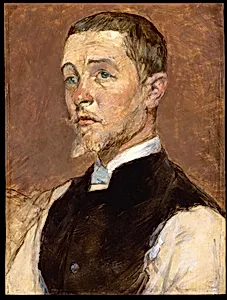
Albert (René) Grenier (1858–1925)
Henri de Toulouse-Lautrec, 1887
About this artwork
Henri de Toulouse-Laut's *Albert (René) Grenier* (1887) captures a moment from the artist's early career, when the young Post-Impressionist honing his skill in intimate portraiture amid the vibrant bohemian circles of late 19th-century Paris At just 23, Lautrec painted his friend Albert (René Grenier (18581925), a figure from his social milieu, in a compact oil on wood panel measuring 13 3/8 x 10 inches. This small-scale format—uncommon for oils, typically reserved for larger canvases—suggests a personal, almost spontaneous study, reflecting Lautrec's fascination with the human face as a window into character. Lautrec's style here foreshadows his later mastery of distorted forms and psychological depth, influenced by Degas and Japanese prints, though still rooted in Impressionist looseness. The work exemplifies his early portraits of friends and acquaintances, blending loose brushwork with acute observation to convey individuality. Housed in the Metropolitan Museum of Art's European Paintings department (Bequest of Mary Cushing Fosburgh, 1978), it offers visitors a glimpse into the pre-Moulin Rouge era of Lautrec's oeuvre, before his iconic posters and nightlife scenes defined fin-de-siècle culture. A charming testament to youthful talent and camaraderie.