
Album Containing Architectural, Ornament, and Figure Drawings
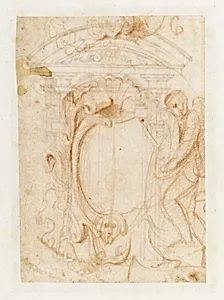
Medium
Various: Pen and ink, wash, black chalk or graphite, red chalk, stylus-incised construction lines.
Dimensions
overall: 7 15/16 x 7 11/16 in. (20.1 x 19.5 cm) folio 2 -- 7-15/16 x 5-3/8 in. (20.1 x 13.7 cm) folio 7 -- 8 x 4-15/16 in. (20.3 x 12.5 cm) folio 9 -- 7-9/16 x 5-1/8 in. (19.2 x 13.0 cm) folio 14 -- 7-3/4 x 5-11/16 in. (19.7 x 14.4 cm) folio 16 -- 7 x 4-13/16 in. (17.8 x 12.3 cm) folio 22v -- 7-5/8 x 5-7/16 in. (19.3 x 13.8 cm) folio 27 -- 7-3/16 x 5-1/2 in. (18.2 x 14.0 cm) folio 31 -- 7-1/2 x 5-1/4 in. (19.0 x 13.4 cm) folio 32 -- 7-5/16 x 4-15/16 in. (18.5 x 12.5 cm) folio 36 -- 7-5/16 x 4-13/16 in. (18.5 x 12.3 cm) folio 42 -- 10-11/16 x 7-5/16 in. (27.1 x 18.5 cm) folio 45 -- 11-1/8 x 8-1/16 in. (28.3 x 20.4 cm) folio 46 -- 7-3/4 x 4-11/16 in. (19.7 x 11.9 cm) folio 47 -- 8-7/16 x 5-1/2 in. (21.4 x 14.0 cm) folio 49 -- 6-3/4 x 7-1/2 in. (17.1 x 19.0 cm) folio 50 --7-15/16 x 7-11/16 in. (20.1 x 19.5 cm)
Classification
Albums
Department
Drawings and Prints
Museum
Metropolitan Museum of Art, New York, NY
Credit
Harry G. Sperling Fund, 1978
Accession Number
1979.62.1(1–66)
Rights
Public Domain
Tags
Art Historical Context
This album of architectural, ornamental, and figure drawings was created in 1630–31 by the father-and-son artists Giovanni Battista Mola and Pier Francesco Mola. Dating to the early Baroque period, it captures the pair’s travels and studies, likely in Italy, where young artists routinely recorded buildings, decorative motifs, and human forms to develop their skills. The collection reflects the era’s fascination with classical antiquity and the emerging interest in dynamic architectural forms that would shape Baroque design. The album employs a rich variety of techniques—pen and ink, wash, black and red chalk, and stylus-incised lines—demonstrating the flexibility of drawing as both a preparatory tool and a finished art form. Each folio, ranging in size from intimate studies to larger sheets, reveals careful observation of structures, ornament, and figures, often combining measured construction lines with lively freehand work. Such sketchbooks served as portable references, preserving ideas that could later inform paintings, frescoes, or architectural projects. Today housed in the Metropolitan Museum’s Department of Drawings and Prints, the album offers visitors a rare glimpse into the working methods of two generations of seventeenth-century artists. Its survival highlights the importance of drawing as a foundation of artistic training and the enduring value of these personal records in understanding Baroque visual culture.
About the Artist
Pier Francesco Mola|Giovanni Battista Mola · 1612–1666
Pier Francesco Mola (1612–1666) was a Roman Baroque painter celebrated for the lyrical quality of his landscapes and the painterly freedom of his figural work, qualities that set him apart from the more rigorous classicism of some of his contemporaries. Born in Coldrerio in the Swiss canton of Ticino, he spent the greater part of his career in Rome, where he underwent an extensive and eclectic for...