
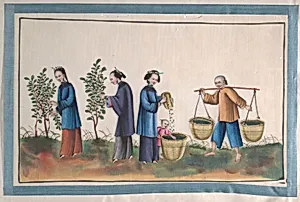
Album Containing Twelve Paintings of People Making Silk
19th century
Medium
Album of twelve leaves; color on pith paper
Dimensions
Image (each): 8 3/4 × 13 1/4 in. (22.2 × 33.7 cm) Overall (album): 9 3/4 × 14 5/8 × 1/2 in. (24.8 × 37.1 × 1.3 cm)
Classification
Paintings
Culture & Period
China · Qing dynasty (1644–1911)
Department
Asian Art
Museum
Metropolitan Museum of Art, New York, NY
Credit
Gift of Mary E. Cornell, 1958
Accession Number
58.79.4a–l
Rights
Public Domain
Tags
Art Historical Context
This enchanting album from China's Qing dynasty (16441911) captures the intricate world of silk production through twelve vivid paintings on pith paper, a delicate medium made from the pith of the paper mulberry tree. Each leaf measures about 8¾ × 13¼ inches, folded into a compact 9¾ × 14⅝-inch album, perfect for collectors. Created by an unidentified artist in the 19 century, it showcases men, women, and children at every stage of sericulture—from feeding silkworms mulberry leaves to spinning, weaving, and dyeing the luxurious threads that made China synonymous with silk worldwide. These works highlight silk's pivotal role in Qing economy and culture, a labor-intensive industry that fueled trade along the Silk Road and with Western markets. Pith paper's translucent quality allowed artists to layer vibrant colors, creating luminous, detailed scenes that feel alive with motion and community effort. Such albums were popular export art, offering foreigners intimate glimpses into Chinese daily life and craftsmanship. Today, this gift to the Metropolitan Museum of Art from Mary E. Cornell in 1958 invites us to marvel at the human hands behind one of history's greatest luxuries, blending artistry with the timeless rhythm of industry.