
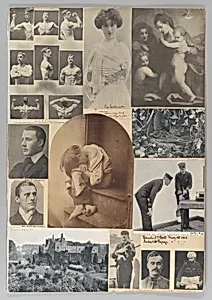
Album page with Poor Jo
Medium
Albumen silver print from glass negative, photomechanical reproductions, ink, and graphite
Dimensions
Mount: 19 7/8 in. × 13 11/16 in. (50.5 × 34.8 cm)
Classification
Photographs
Department
Photographs
Museum
Metropolitan Museum of Art, New York, NY
Credit
Gilman Collection, Museum Purchase, 2005
Accession Number
2005.100.891
Rights
Public Domain
Art Historical Context
This captivating album page, titled *Poor Jo* and dated around 1902, brings together the pioneering spirit of two notable figures in photography: Oscar Gustav Rejlander, a Swedish-born master of early pictorial photography known for his innovative combination printing techniques, and George James Howard, 9th Earl of Carlisle, an aristocratic artist and avid photographer who collected and curated such works. Housed in the Metropolitan Museum of Art's Gilman Collection, it exemplifies the intimate, scrapbook-like albums popular among late 19th- and early 20th-century elites, blending artistry with personal expression. Crafted as an albumen silver print from a glass negative—the era's gold standard for sharp, warm-toned images—the page also incorporates photomechanical reproductions, ink, and graphite for annotations or embellishments. Measuring nearly 20 by 14 inches on its mount, it likely features a poignant portrait evoking "Poor Jo," a character symbolizing urban poverty from Charles Dickens' *Bleak House*. Rejlander's influence shines through in its staged realism, while Howard's touch adds a layer of aristocratic refinement. Such pages highlight photography's evolution from documentary tool to artistic medium, capturing social themes amid technical innovation. Visitors will appreciate how this mixed-media gem bridges Victorian sentimentality and modernist experimentation, offering a window into a world where images told stories of hardship and humanity.