
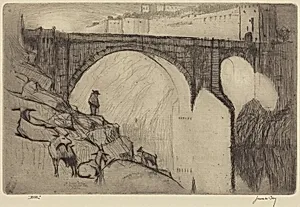
Alcantara Bridge, Toledo
1911
Medium
etching and drypoint
Dimensions
sheet: 18.5 × 25.3 cm (7 5/16 × 9 15/16 in.)
Classification
Department
CG-W
Museum
National Gallery of Art, Washington, D.C.
Credit
Rosenwald Collection
Accession Number
1943.3.5876
Rights
Public Domain
Art Historical Context
James McBey's *Alcantara Bridge, Toledo* (1911) captures the timeless grandeur of one of Spain's most iconic Roman engineering marvels. Perched over the Tagus River in Toledo, ancient Alcantara Bridge—built in the 2nd century AD—stands as a testament to imperial might, with its sturdy arches and triumphal archway. McBey, a Scottish artist renowned for his travels and printmaking prowess, visited Spain during this period, translating the bridge's dramatic silhouette against the river and sky into a masterful etching. Created amid the early 20th-century etching revival, the work reflects McBey's eye for architectural drama and atmospheric light, evoking the romantic allure of historic Europe just before World War I. Rendered in etching and drypoint on a modest sheet (18.5 × 25.3 cm), this print showcases McBey's technical virtuosity. Etching uses acid to incise precise lines into a metal plate, while drypoint adds a soft, velvety burr from direct needle scratching, yielding rich tonal depths and subtle textures that mimic the bridge's stone and the river's shimmer. Housed in the National Gallery of Art's Rosenwald Collection, it exemplifies the intimate power of prints as democratic art forms, allowing wide appreciation of distant wonders. This piece invites visitors to ponder enduring human achievement, blending McBey's modern precision with antiquity's echo—a perfect gem for print enthusiasts.
About the Artist
James McBey · 1883–1959
James McBey (1883–1959) was a Scottish artist renowned for his etchings and paintings, emerging from humble beginnings in Newburgh, Aberdeenshire, as the illegitimate son of a blacksmith's daughter. Largely self-taught, he left school at fifteen to work as a bank clerk in Aberdeen, where he devoured art books from the public library and attended evening classes at Gray's School of Art to hone his ...