
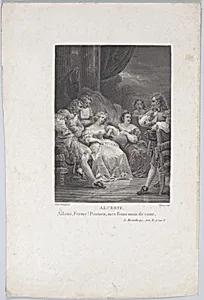
Alceste
ca. 1840
Medium
Engraving
Dimensions
Sheet (Trimmed): 8 3/16 × 5 3/8 in. (20.8 × 13.7 cm) Image: 4 7/16 × 3 1/4 in. (11.2 × 8.2 cm)
Classification
Prints
Department
Drawings and Prints
Museum
Metropolitan Museum of Art, New York, NY
Credit
Harris Brisbane Dick Fund, 1933
Accession Number
33.104.2445
Rights
Public Domain
Art Historical Context
"Alceste," an engraving from around 1840, captures a dramatic moment likely inspired by the ancient Greek myth of Alcestis, who heroically offered her life to save her husband Admetus Created by engraver Prevost after a composition by the renowned French Romantic painter Horace Vernet (1789–1863), this print Vernet's flair for theatrical history and literary subjects. Vernet, celebrated for his dynamic battle scenes and Orientalist works, infused his art with emotional intensity, bridging Neoclassicism and Romanticism during a time when France was enthralled by grand narratives from antiquity. The medium of engraving holds particular significance: using a burin to incise fine lines into a metal plate, Prevost translated Vernet's painted imagery into a reproducible format. Measuring just 8 3/16 × 5 3/8 inches (trimmed), this intimate sheet allowed wide dissemination of elite art to 19th-century collectors and enthusiasts. Prints like this democratized access to high culture, reflecting the era's booming print market fueled by Romantic revivalism. Acquired through the Harris Brisbane Dick Fund in 1933, "Alceste" resides in The Metropolitan Museum of Art's Drawings and Prints department. It invites visitors to ponder themes of sacrifice and love, while showcasing the meticulous craft that made Vernet's vision enduringly accessible.
About the Artist
Prevost|Horace Vernet (French) · 1820 –1881
French, 1820–1881