
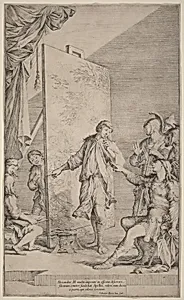
Alexander in the Studio of Apelles
c. 1662
Medium
etching and drypoint on laid paper
Dimensions
sheet (trimmed to plate mark): 45.5 x 27.5 cm (17 15/16 x 10 13/16 in.)
Classification
Department
CG-E
Museum
National Gallery of Art, Washington, D.C.
Credit
Ailsa Mellon Bruce Fund
Accession Number
1985.63.1
Rights
Public Domain
Art Historical Context
Step into the dramatic world of 17th-century Baroque art with *Alexander in the Studio of Ap*, an etching and drypoint by Italian master Salvator Rosa, created around 1662. Rosa, a multifaceted artist celebrated for his turbulent landscapes, history scenes, and rebellious spirit, draws from a famous anecdote in ancient Greek history. Alexander the Great enters the studio of his court painter Apelles, the artist at work on a portrait of the beautiful Pancaspe—whom Alexander later gifts to Apelles in admiration of his talent. This print captures the tension and grandeur of artistic patronage, blending classical mythology with Baroque intensity. Rosa's mastery shines in his use of etching and drypoint on laid paper, techniques that allowed for intricate lines and velvety textures. Etching creates precise, fluid contours through acid-etched plates, while drypoint's hand-scratched burr adds rich, tonal depth, giving the 45.5 x 27.5 cm composition a painterly quality rare in prints. As one of Rosa's evocative etchings, it exemplifies his innovative printmaking during Rome's vibrant Baroque era, bridging painting and graphic arts. Housed in the National Gallery of Art through the Ailsa Mellon Bruce Fund, this work highlights the enduring cultural reverence for art's power to captivate even the mightiest rulers—a timeless nod to creativity's triumph.
About the Artist
Salvator Rosa · 1615–1673
Salvator Rosa was born in 1615 in Arenella, on the outskirts of Naples, into a world of artistic ambition and turbulent talent. His early training came through his maternal uncle, the painter Paolo Greco, and his brother-in-law Francesco Fracanzano, himself a pupil of the great Spanish-born Neapolitan master Jusepe de Ribera. Rosa showed a fierce independence from the start, resisting his father's...