
Alexander the Great (?)
Unknown Artist
ring: mid-16th century; cameo: early Hellenistic 4th century BCE
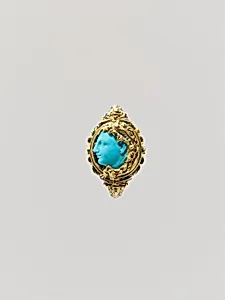
Medium
Turquoise, enamel, gold
Dimensions
Overall (ring setting): 1 x 1 1/16 in. (2.6 x 2.7 cm); Visible cameo (confirmed): 11 x 9.6 mm
Classification
Metalwork-Gold and Platinum|Jewelry
Culture
probably Italian
Department
European Sculpture and Decorative Arts
Museum
Metropolitan Museum of Art, New York, NY
Credit
Rogers Fund, 1910
Accession Number
10.110.2
Rights
Public Domain
Tags
Art Historical Context
This delicate gold ring, adorned with turquoise and enamel, showcases a remarkable fusion of ancient and Renaissance artistry. At its center is a tiny cameo—measuring just 11 x 9.6 mm—likely portraying Alexander the Great in profile, carved in the early Hellenistic period around the 4th century BCE. The setting itself dates to mid-16th-century Italy, transforming this ancient gem into wearable jewelry. ameos like this were prized in antiquity for their intricate intaglio carving, often using hardstones to create raised images against a contrasting background. Revived during the Renaissance, they symbolized a humanist fascination with classical heroes. Alexander, the legendary conqueror, embodied ideals of ambition and glory, making his image a popular motif for elite adornment. Acquired through the Rogers Fund in 1910, this piece from the Metropolitan Museum of Art's European Sculpture and Decorative Arts collection highlights how Renaissance jewelers repurposed ancient artifacts, bridging eras in a single, intimate object. A testament to enduring admiration for the ancient world!