
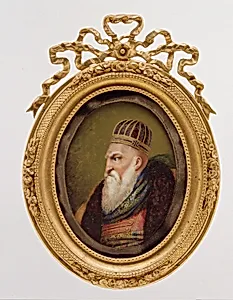
Ali Pasha (born about 1741, died 1822)
Medium
Ivory
Dimensions
Oval, 4 1/8 x 3 1/4 in. (105 x 84 mm)
Classification
Miniatures
Department
European Paintings
Museum
Metropolitan Museum of Art, New York, NY
Credit
The Moses Lazarus Collection, Gift of Josephine and Sarah Lazarus, in memory of their father, 1888–95
Accession Number
95.14.52
Rights
Public Domain
Tags
Art Historical Context
This exquisite ivory miniature portrait, titled *Ali Pasha (born about 1741, 1822)*, the formidable Ottoman governor known as the "Lion ofina" in a precise profile view. Created by the German miniaturist Jacob Ritter von in 1822—the year of Ali Pasha's dramatic death—it exemplifies the refined art of 19th-century European portrait miniatures. Measuring just 4 1/8 x 3 1/4 in an oval format, these diminutive works were prized as intimate keepsakes, often worn as jewelry or displayed in private collections. Ali Pasha rose to power as the semi-independent ruler of Yanina (modern Ioannina, Greece), amassing wealth and influence through cunning diplomacy and military prowess amid the declining Ottoman Empire. His larger-than-life persona captivated European Romantic writers like Lord Byron, who encountered him during travels. Hartmann's rendition, with its meticulous engraving on ivory, highlights the medium's unique translucency, allowing subtle tonal gradations that convey the subject's stern gaze and aristocratic bearing—hallmarks of profile portraits evoking ancient Roman coins. Housed in the Metropolitan Museum of Art's European Paintings department as part of The Moses Lazarus Collection (gifted 1888–95), this piece bridges Eastern intrigue with Western artistic tradition, offering visitors a tangible glimpse into a turbulent era of empire and rebellion.