
Alle glorie della pittura
1760 - 1799
Medium
etching
Dimensions
453; 553
Rights
Public Domain
About this artwork
ets
Art Historical Context
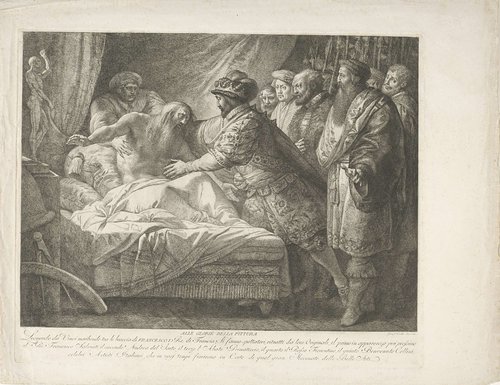
Giuseppe Cades' *Alle glorie della pittura (To the Glories of Painting), created between 1760 and 1799, is a etching that pays homage to the noble art of painting. This Italian artist, active in Rome during the late Enlightenment era, was renowned for his engravings and history paintings influenced by emerging neoclassical ideals, blending rococo elegance with classical restraint. The title itself evokes a celebratory ode, likely featuring allegorical figures or scenes exalting painters and their craft amid the vibrant artistic circles of 18th-century Italy. Measuring an impressive 453 × 553 mm, this large-scale etching stands out for its ambitious format, suitable for prominent display in scholarly or aristocratic collections. Etching, Cades' chosen medium, involved coating a copper plate with acid-resistant ground, incising a design, and submerging it in acid to bite the lines—allowing for expressive, fluid marks that captured intricate details with remarkable precision. This technique democratized art by enabling multiple impressions from a single plate, making grand themes accessible beyond oil paintings. As a tribute from a printmaker to painting, the work highlights the interconnected glories of visual arts in Cades' time, when Rome buzzed with academies and grand tours. Visitors, imagine it adorning a salon, inspiring awe at painting's timeless prestige!