
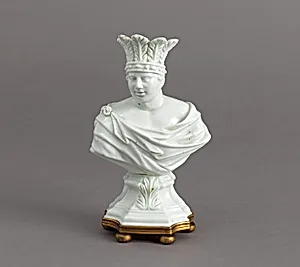
Allegorical Bust of "America"
mid- 18th century
Classification
ceramics
Department
Smithsonian Collection
Museum
Smithsonian American Art Museum
Credit
Bequest of Erskine Hewitt
Accession Number
1938-57-379
Rights
Public Domain
About this artwork
Research in Progress
Art Historical Context
### Allegorical Bust of "" Crafted by the esteemed Saint-Cloud Porcelainufactory in France, active from around 1693 to 1766, this mid-18th-century ceramic bust exemplifies the era's mastery of soft-paste porcelain. One of France's earliest porcelain producers, Saint- gained fame for its delicate, creamy-white figures and decorative wares, rivaling Chinese imports during the opulent Rococo period. This allegorical representation of "America" likely personifies the New World as a classical female figure, adorned with symbolic attributes evoking exoticism and colonial ambition—common motifs in European art that romanticized distant continents. The bust's artistic significance lies in its technical virtuosity: porcelain's translucency and fine modeling allowed for lifelike expressions and intricate details, showcasing the manufactory's innovative glazing and firing techniques. Produced amid France's expanding global trade and Enlightenment curiosity, it reflects cultural fascination with the Americas, blending mythology with emerging imperialism. Now part of the Smithsonian American Art Museum's collection through the bequest of collector Erskine Hewitt, this piece invites reflection on how 18th-century Europeans envisioned the "New World." Ongoing research promises deeper insights into its motifs and provenance, enriching our understanding of transatlantic exchanges. (198 words)