
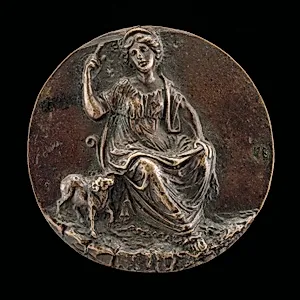
Allegorical Figure
c. 1500
Medium
bronze//Medium brown patina
Dimensions
overall (diameter): 5.5 cm (2 3/16 in.) gross weight: 61 gr
Classification
Sculpture
Department
CSD
Museum
National Gallery of Art, Washington, D.C.
Credit
Samuel H. Kress Collection
Accession Number
1957.14.415
Rights
Public Domain
Art Historical Context
This small bronze plaquette, created by an anonymous North Italian artist around 1500, exemplifies the Renaissance revival of classical themes and humanist ideals. Titled simply *Allegorical Figure*, the work likely depicts a symbolic personification—common in the period to represent virtues, seasons, or mythological concepts—rendered in a compact, circular format suited for private contemplation or collection. North Italian workshops during this era flourished under the patronage of courts and scholars who valued such portable objects as bridges between ancient Roman coinage and contemporary artistic expression. Crafted in bronze with a warm medium-brown patina, the piece highlights the material’s enduring appeal for Renaissance sculptors. Bronze allowed for intricate detailing through casting techniques while developing a rich surface over time, enhancing both aesthetic beauty and tactile appeal. At just 5.5 centimeters in diameter, it reflects the growing popularity of small-scale sculpture as affordable art for educated collectors. Today in the National Gallery of Art’s Samuel H. Kress Collection, this object offers visitors a tangible connection to early 16th-century Italy’s cultural fascination with allegory and classical learning. Its modest scale belies the sophisticated artistry and intellectual depth characteristic of the period.