
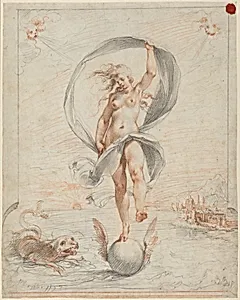
Allegorical Figure
probably c. 1588
Medium
black and red chalk on laid paper
Dimensions
Overall: 29.3 x 23.3 cm (11 9/16 x 9 3/16 in.) support: 35.8 x 29.7 cm (14 1/8 x 11 11/16 in.)
Classification
Drawing
Department
CG-E
Museum
National Gallery of Art, Washington, D.C.
Credit
Andrew W. Mellon Fund
Accession Number
1977.44.1
Rights
Public Domain
Art Historical Context
Created around 1588 by the Roman artist Giuseppe Cesari, known as Cavaliere d’Arpino, this drawing captures the graceful elegance typical of late Mannerist figure studies. Cesari, who would later receive a knighthood for his decorative frescoes in Roman churches and palaces, often explored allegorical themes that blended classical ideals with Christian symbolism. The sheet likely served as a preparatory study, allowing the artist to refine pose, drapery, and expression before transferring the design to a larger painting or fresco. Executed in black and red chalk on laid paper, the work demonstrates the expressive potential of this medium. The red chalk lends warmth to flesh tones and highlights, while the black chalk provides structure and shadow, creating a subtle sense of volume and movement. Such drawings were prized in the sixteenth century both as independent works of art and as records of an artist’s creative process. Acquired by the National Gallery of Art through the Andrew W. Mellon Fund, the drawing offers visitors an intimate glimpse into the working methods of one of Rome’s most influential painters at the close of the Renaissance.