
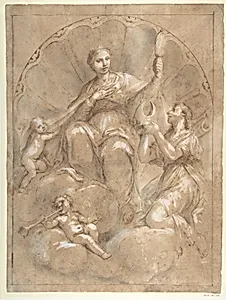
Allegorical Figure of Faith
1648–1729
Medium
Pen and brown ink, brush and gray wash, highlighted with white, on brown washed paper
Dimensions
15 11/16 x 11 3/4in. (39.8 x 29.8cm)
Classification
Drawings
Department
Drawings and Prints
Museum
Metropolitan Museum of Art, New York, NY
Credit
Bequest of Harry G. Sperling, 1971
Accession Number
1975.131.26
Rights
Public Domain
Tags
Art Historical Context
Marcantonio Franceschini (1648–1729), a prominent Bolognese of the late Baroque era, crafted this exquisite drawing titled *Allegorical Figure of Faith* as a preparatory study, likely for a larger painting or fresco. Executed in pen and brown ink with brush and gray wash, with white on brown-washed paper, the 15 11/16 x 11 3/4-inch sheet (39.8 x 29.8 cm) exemplifies the technical virtuosity of 17th- and 18th-century draftsmanship. These mixed-media techniques allowed artists like Franceschini to explore light, shadow, and form with remarkable fluidity, capturing movement and depth on a modest scale. At its heart, the composition features a graceful female figure embodying Faith, accompanied by lively putti—those charming cherubic children ubiquitous in Baroque allegory—and musical instruments, which evoke harmony, divine praise, and spiritual elevation. Such motifs were common in allegorical art, blending religious devotion with decorative exuberance to inspire viewers in churches or palaces. Today, this drawing resides in the Metropolitan Museum of Art's Department of Drawings and Prints, thanks to the 1971 bequest of Harry G. Sperling. It offers a window into Franceschini's workshop practices, highlighting how sketches bridged imagination and grand-scale commissions in Italy's vibrant artistic tradition.