
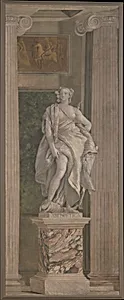
Allegorical Figure Representing Arithmetic
Medium
Fresco, transferred to canvas
Dimensions
146 x 57 7/8 in. (370.8 x 147 cm)
Classification
Paintings
Department
European Paintings
Museum
Metropolitan Museum of Art, New York, NY
Credit
Bequest of Grace Rainey Rogers, 1943
Accession Number
43.85.14
Rights
Public Domain
Tags
Art Historical Context
In the grand tradition of 18th-century Venetian frescoes, *Allegorical Figure Representing* (1760) showcases a masterful collaboration between Giovanni Battista Tiepolo, celebrated Rococo master known for his luminous, theatrical compositions, and Girolamoozzi (called Colonna a specialist in illusionistic architecture. Tiep's elegant female figure personifies Arithmetic—one of the seven liberal arts—poised with classical poise amid Colonna's trompe-l'œil architectural framing, blurring the line between painting and sculpture. This work evokes the Enlightenment-era fascination with knowledge, where abstract concepts like mathematics were vividly humanized for palace interiors. Originally a fresco painted on wet plaster for seamless integration into walls or ceilings, it was later transferred to canvas—a meticulous 19th-century technique that preserved its vibrant colors and scale (nearly 12 feet tall). Measuring 146 x 57 7/8 inches, the monumental piece highlights the fresco medium's durability and Tiepolo's bravura in light and movement, influencing grand decorative schemes across Europe. Today, housed in the Metropolitan Museum of Art's European Paintings department (Bequest of Grace Rainey Rogers, 1943), it invites us to marvel at how art elevated everyday learning into divine allegory, bridging antiquity and the opulent Rococo age.
About the Artist
Girolamo Mengozzi (called Colonna)|Giovanni Battista Tiepolo (Italian|Italian) · 1688 |1696 –1766 |1770
Italian, Venetian, 1688–ca. 1766|Italian, Venice 1696–1770 Madrid