
Allegorical Figures
17th century
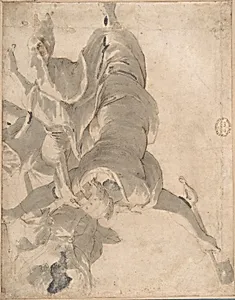
Medium
Pen and brown ink, brush and gray wash, over faint traces of black chalk on light brown paper
Dimensions
6-15/16 x 5-3/8 in. (17.7 x 13.7 cm)
Classification
Drawings
Department
Drawings and Prints
Museum
Metropolitan Museum of Art, New York, NY
Credit
Gift of Cornelius Vanderbilt, 1880
Accession Number
80.3.274
Rights
Public Domain
Tags
Art Historical Context
This delicate drawing, created by an anonymous Bolognese artist in the seventeenth century, captures the essence of Baroque draftsmanship through its expressive use of line and tone. Titled *Allegorical Figures*, the work features human forms that likely symbolize abstract concepts such as virtue, time, or the arts popular theme in Italian art the period. Executed in pen and brown ink with gray wash over faint black chalk on light brown paper, the piece demonstrates the fluid, economical techniques favored by artists of the Bolognese school, who often prepared such studies for larger paintings or frescoes. Measuring just under seven by five-and-a-half inches, this intimate work reflects the vibrant artistic culture of seventeenth-century Bologna, a city renowned for its emphasis on naturalism and classical ideals. The faint chalk underdrawing and layered washes suggest a spontaneous yet thoughtful process, allowing the artist to explore composition and light effects quickly. Now part of the Metropolitan Museum of Art’s collection through the 1880 gift of Cornelius Vanderbilt, the drawing offers visitors a glimpse into the preparatory stages of Baroque art, where even small sketches carried significant creative weight.