
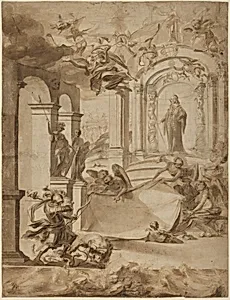
Allegory in Honor of a Gentleman
3rd quarter of the 17th century
Medium
pen and brown ink with brown wash over graphite
Dimensions
overall: 49.3 x 37.8 cm (19 7/16 x 14 7/8 in.)
Classification
Drawing
Department
CG-E
Museum
National Gallery of Art, Washington, D.C.
Credit
Julius S. Held Collection
Accession Number
1985.1.11
Rights
Public Domain
Art Historical Context
Created in the third quarter of the 17th century during the Dutch Golden Age, *Allegory in Honor of a Gentleman* reflects the period’s rich tradition of symbolic imagery. Dutch artists frequently employed allegory to celebrate patrons, civic leaders, or distinguished individuals, blending portraiture with moral or mythological elements. This drawing, attributed simply to a 17th-century Dutch hand, likely served as a tribute that elevated its subject through classical or emblematic motifs. The work’s medium—pen and brown ink with brown wash over graphite—highlights the artist’s technical skill. Graphite provided an initial framework, while the ink and wash added depth, modeling, and dramatic contrast. Such drawings were valued both as independent works of art and as studies for larger paintings or prints, showcasing the fluid, expressive draftsmanship prized in the Netherlands at the time. Now part of the National Gallery of Art’s Julius S. Held Collection, the sheet offers viewers a window into 17th-century Dutch cultural values, where art often honored personal achievement within a prosperous, intellectually engaged society. Its substantial size further suggests it was intended for display or careful study.