
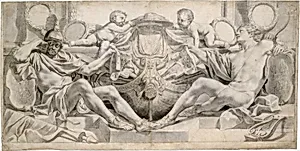
Allegory in Honor of Cardinal Richelieu
Charles Le Brun, 1641
About this artwork
Created in 1641 by Charles Le, a leading French artist who would later dominate the court of Louis XIV and found the Royal Academy of Painting and Sculpture, *Allegory in Honor of Cardinalhelieu* is a masterful preparatory drawing. Measuring an expansive 14 11/16 x 29 1/2 inches, it celebrates Armand Jean du Plessis, the powerful chief minister to Louis XIII, whose influence shaped France's golden age through patronage of the arts, politics, and military might. The incised contours suggest it was designed for transfer to a larger painting or tapestry, showcasing Le Brun's early prowess at age 32. Rendered in black chalk with traces of stumping for soft blending, brush, and black-and-gray wash, the work exemplifies 17th-century French draftsmanship. This technique allowed Le Brun to achieve dramatic tonal contrasts and fluid modeling, bridging Baroque dynamism with emerging classicism—hallmarks of his style. Allegorical figures like Apollo (god of arts and music), Mars (war god), and Cupid (love's embodiment) intertwine with musical instruments and a coat of arms, symbolizing Richelieu's orchestration of culture, power, and harmony amid France's turbulent wars and cultural ascent. Today, housed in the Metropolitan Museum of Art's Drawings and Prints department (acquired via the Harry G. Sperling Fund in 1974), this sheet offers a window into absolutist France, where art glorified statesmen as near-divine. It's a testament to how drawings like this fueled grand commissions, blending myth and reality in service of legacy.