
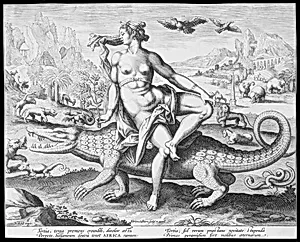
Allegory of Africa, from "The Four Continents"
1580–1600
Medium
Engraving; second state of three
Dimensions
sheet: 8 3/16 x 10 3/16 in. (20.8 x 25.9 cm) (clipped)
Classification
Prints
Department
Drawings and Prints
Museum
Metropolitan Museum of Art, New York, NY
Credit
Gift of the Estate of James Hazen Hyde, 1959
Accession Number
59.654.9
Rights
Public Domain
Tags
Art Historical Context
In the late 16th century, artists Maerten de Vos and Aden Collaert collaborated on *Allegory of Africa*, part of the renowned series *The Four Contin*. De Vos, a leading Mannerist painter known for his intricate allegories and religious scenes, likely designed the composition, while Collaert a master engraver, translated it into this detailed print. Created between 1580 and 1600, it exemplifies the Northern Renaissance fascination with personifying the known world, reflecting Europe's expanding global awareness during the Age of Exploration. The engraving depicts Africa as a majestic female nude, surrounded by iconic wildlife—lions, elephants, crocodiles, and exotic birds—that symbolize the continent's untamed power and biodiversity. This allegorical tradition drew from classical antiquity and medieval cartography, portraying continents as nurturing yet formidable matriarchs to convey moral and geographical lessons to educated viewers. As a second state of three in engraving—a meticulous intaglio technique on a clipped 8 3/16 x 10 3/16-inch sheet—this print allowed widespread dissemination of de Vos's vision. Housed in the Metropolitan Museum of Art's Drawings and Prints department (gift of the Estate of James Hazen Hyde, 1959), it highlights engraving's role in democratizing art, bridging elite patronage with broader audiences eager for worldly wonders.