
Allegory of Air and Earth
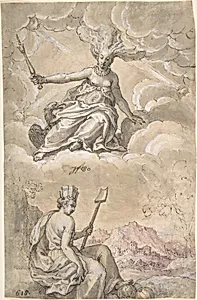
Medium
Pen and brown ink with gray and violet wash and white heightening over black chalk and graphite
Dimensions
sheet: 12 1/4 x 7 15/16 in. (31.1 x 20.1 cm)
Classification
Drawings
Department
Drawings and Prints
Museum
Metropolitan Museum of Art, New York, NY
Credit
Van Day Truex Fund, 2001
Accession Number
2001.530
Rights
Public Domain
Tags
Art Historical Context
Created in 1618 by the German artist Bartholomäus Reiter, *Allegory of Air and Earth* exemplifies the early Baroque interest in personifying the natural elements. The drawing presents two female nudes as symbolic figures, a convention rooted in classical mythology and revived during the Renaissance to explore humanity’s relationship with the cosmos. Though little is documented about Reiter’s career, this sheet reflects the period’s fascination with allegorical subjects that blended intellectual themes with graceful, idealized forms. The work’s refined technique highlights Reiter’s mastery of mixed media. Executed in pen and brown ink with delicate gray and violet washes, white heightening, and underlying black chalk and graphite, the drawing achieves luminous contrasts and subtle modeling. Such layered methods were prized in the seventeenth century for preparatory studies and presentation pieces alike, allowing artists to suggest volume and atmosphere on paper. Acquired by the Metropolitan Museum of Art in 2001 through the Van Day Truex Fund, this sheet offers visitors a vivid glimpse into the visual language of elemental allegory. Its intimate scale—roughly twelve by eight inches—invites close looking, rewarding viewers with the quiet elegance of Reiter’s line and the timeless appeal of nature personified.