
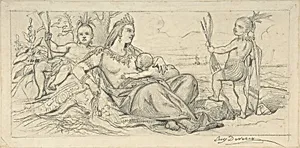
Allegory of America
mid-19th century
Medium
Graphite
Dimensions
Sheet: 6 3/8 x 13 1/16 in. (16.2 x 33.1cm)
Classification
Drawings
Department
Drawings and Prints
Museum
Metropolitan Museum of Art, New York, NY
Credit
Gift of the Estate of James Hazen Hyde, 1959
Accession Number
59.208.97
Rights
Public Domain
Tags
Art Historical Context
Eugène Devéria's *Allegory of America*, a delicate graphite drawing from the mid-19th century, captivatingly personifies the New World through symbolic figures. Rendered on a modest sheet measuring 6 3/8 x 13 1/16 inches, the work likely features maternal and youthful motifs—mothers with boys, girls, and infants—as suggested by its tags, evoking themes of fertility, growth, and promise. Devéria, a prominent French Romantic artist known for his elegant portraits and historical scenes, infused his drawings with a lyrical grace, blending neoclassical precision with emotional depth. Created during a period of European fascination with the Americas amid expanding colonial and commercial ties, this piece reflects 19th-century allegorical traditions, where continents were often depicted as nurturing female figures surrounded by progeny to symbolize prosperity and expansion. Graphite, a versatile medium favored for its subtle tonal range and portability, allowed Devéria to capture fluid lines and soft shading, ideal for preparatory sketches that bridge studio painting and finished art. Housed in the Metropolitan Museum of Art's Drawings and Prints department, thanks to a 1959 gift from the Estate of James Hazen Hyde, *Allegory of America* offers visitors a window into Romantic-era imagination. Its intimate scale invites close contemplation, revealing how artists like Devéria wove cultural ideals into everyday symbolism, celebrating America's emergent identity on paper.