
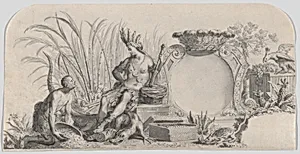
Allegory of America
ca. 1696
Medium
Brush and gray ink, over graphite, incised for transfer
Dimensions
Sheet: 5 3/4 × 11 3/8 in. (14.6 × 28.9 cm), the top corners rounded
Classification
Drawings
Department
Drawings and Prints
Museum
Metropolitan Museum of Art, New York, NY
Credit
Frits and Rita Markus Fund, 2014
Accession Number
2014.755
Rights
Public Domain
Tags
Art Historical Context
Created around 1696 by Dutch artist Philip Tideman, *Allegory of America* is a delicate preparatory drawing executed in brush and gray ink over graphite, with incised lines indicating it was designed for transfer to a printing plate. Such works were common in the late seventeenth century, when artists produced detailed studies for engravings that would adorn books, maps, and decorative prints celebrating the expanding European worldview. The composition reflects the era’s fascination with the four continents, portraying America through symbolic figures and natural elements. Tags reveal the presence of men, female nudes, animals, plants, and cartouches—motifs that evoke the exotic flora, fauna, and peoples of the New World as imagined by Europeans during the Age of Exploration. Tideman’s refined line work captures these themes with graceful precision, blending mythological and ethnographic imagery typical of Baroque allegorical design. Housed in the Metropolitan Museum’s Department of Drawings and Prints, this small sheet (just under six by twelve inches) offers a window into how knowledge of distant lands was visualized and disseminated across Europe at the time. Its elegant execution highlights both artistic skill and the cultural curiosity that shaped early modern print culture.