
Allegory of Envy
c. 1505
Medium
Engraving on paper
Dimensions
23.3 × 18 cm (9 3/16 × 7 1/8 in.)
Classification
engraving
Department
Prints and Drawings
Museum
Art Institute of Chicago
Accession Number
4373
Rights
Public Domain
About this artwork
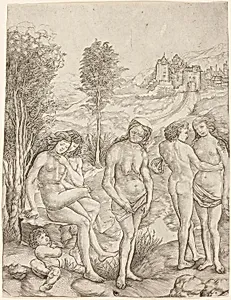
Flanked by younger couples entwined in erotic poses, an unaccompanied older woman appears to scowl. It is unclear whether the central figure, traditionally identified with envy, is the one experiencing the feeling or merely a visual symbol of it. Secular allegorical subjects were popular with Renaissance printmakers, especially in Italy. In this case, the Florentine engraver Cristofano Robetta copied German prints by Albrecht Dürer for the landscape in the background.
Art Historical Context
Cristofano Robetta's *Allegory of En*, created around 1505, is a engraving on paper measuring 23.3 × 18 cm, housed in the Art Institute of's Prints and Drawings Department As an early 16th-century Italian artist from Florence, Robetta was a master engraver influenced by the Renaissance's fascination with classical antiquity and moral allegories. This print exemplifies the period's use of personified vices to convey ethical lessons, with Envy depicted as aary figure amid symbolic elements that would have resonated with Renaissance viewers steeped in humanist thought and Christian morality. Engraving, Robetta's preferred medium, involved incising intricate designs into a copper plate, inking it, and pressing paper to capture fine lines and textures unachievable in painting. This technique revolutionized art dissemination, allowing affordable multiples for collectors, scholars, and the emerging middle class. Robetta's precise, expressive style—drawing from predecessors like Antonio Pollaiuolo—blends detailed narrative with dynamic composition, making complex allegories accessible and visually compelling. Today, this work highlights the print's role in Renaissance visual culture, bridging elite patronage and broader education. Visitors can appreciate how Robetta captured human frailty in enduring lines, inviting reflection on timeless vices.