
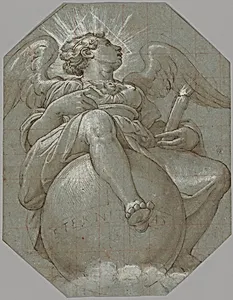
Allegory of Eternity
1544/45
Medium
Pen and brown ink, brush and brown wash, over black chalk, heightened with white gouache, on blue laid paper, squared for transfer in red chalk
Dimensions
28.3 × 21.9 cm (11 3/16 × 8 5/8 in.)
Classification
drawings (visual works)
Department
Prints and Drawings
Museum
Art Institute of Chicago
Accession Number
244911
Rights
Public Domain
Art Historical Context
Giorgio Vasari’s “Allegory of Eternity,” created in 1544–45, offers a window into the symbolic language of the late Renaissance. Vasari, celebrated both as an artist and the author of “Lives of the Artists,” frequently explored moral and philosophical themes in his work. Here the title suggests a meditation on timelessness, virtue, and the lasting power of artistic creation, rendered through graceful figures whose precise identities remain open to interpretation. Executed in pen and brown ink with brush and wash over black chalk on blue paper, the drawing is heightened with white gouache to produce a luminous, almost sculptural effect. Red-chalk squaring visible across the surface indicates the sheet served as a preparatory study intended for transfer to a larger painting or fresco. This meticulous technique underscores the careful planning that underpinned ambitious sixteenth-century projects. Measuring just over eleven by eight inches, the work now resides in the Art Institute of Chicago’s Prints and Drawings collection. It invites viewers to appreciate both the intellectual depth of Renaissance allegory and the technical sophistication of Vasari’s draftsmanship.
About the Artist
Giorgio Vasari · 1511–1574
Vasari was a productive court artist and architect in Florence during the first half of the 16th century, with his primary patrons being Alessandro and Ippolito de' Medici, until 1537 with the death of Alessandro. However, he is most well known for his book "Le vite de' più eccellenti architetti, pittori, et scultori Italiani," which was first published in 1550, and once again in 1568 in an expand...