
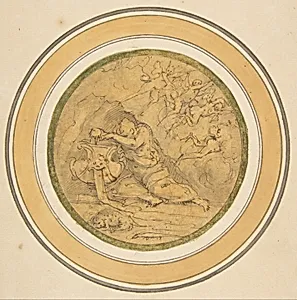
Allegory of Forgetfulness
ca. 1570
Medium
Pen and brown ink, brush and pale gray wash, over traces of black chalk, on beige paper
Dimensions
Diameter: 3-11/16 in. (9.4 cm)
Classification
Drawings
Department
Drawings and Prints
Museum
Metropolitan Museum of Art, New York, NY
Credit
Rogers Fund, 1967
Accession Number
67.95.3
Rights
Public Domain
Tags
Art Historical Context
Giorgio Vasari’s *Allegory of Forgetfulness*, created around 1570, offers a delicate glimpse into the refined world of late Renaissance draftsmanship. Vasari, the celebrated Tuscan painter, architect, and author of *Lives of the Artists*, frequently explored allegorical subjects that blended classical mythology with moral philosophy. This small circular drawing likely served as a design for a decorative object such as a medal, plate, or ceiling ornament, reflecting the period’s taste for intimate, symbolic imagery meant to prompt reflection on memory and oblivion. Executed in pen and brown ink with pale gray wash over faint black chalk, the work demonstrates Vasari’s masterful control of line and tone. The technique allows subtle gradations of light and shadow within a compact format, creating a sense of depth and movement on the beige paper. Such preparatory studies were essential to Vasari’s practice, enabling him to experiment with compositions before translating them into larger paintings or architectural schemes. As a Mannerist artist working in the orbit of the Medici court, Vasari infused even modest drawings with intellectual sophistication. The presence of female figures suggests an exploration of Forgetfulness as both a gentle release from earthly cares and a cautionary force, themes that resonated in an era preoccupied with fame, legacy, and the passage of time.
About the Artist
Giorgio Vasari · 1511–1574
Vasari was a productive court artist and architect in Florence during the first half of the 16th century, with his primary patrons being Alessandro and Ippolito de' Medici, until 1537 with the death of Alessandro. However, he is most well known for his book "Le vite de' più eccellenti architetti, pittori, et scultori Italiani," which was first published in 1550, and once again in 1568 in an expand...