
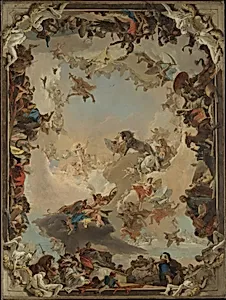
Allegory of the Planets and Continents
Medium
Oil on canvas
Dimensions
73 x 54 7/8 in. (185.4 x 139.4 cm)
Classification
Paintings
Department
European Paintings
Museum
Metropolitan Museum of Art, New York, NY
Credit
Gift of Mr. and Mrs. Charles Wrightsman, 1977
Accession Number
1977.1.3
Rights
Public Domain
Tags
Art Historical Context
Giovanni Battista Tiepolo, a virtuoso of the Venetian Rococo style, created *Allegory of the Planets and Continents* in 1752 as a grand oil-on-canvas painting (73 x 54 7/8 in.). This exuberant work exemplifies Tiepolo's mastery of illusionistic decoration, originally designed as an overdoor for the opulent Ca’ Rezzonico palace in Venice. Rococo art, with its playful elegance and theatrical flair, reached new heights in Tiepolo's hands, blending mythological grandeur with dynamic movement to celebrate cosmic and earthly harmony during Europe's Age of Enlightenment. The composition bursts with allegorical figures representing planets and continents, featuring nude men and women in fluid, idealized poses alongside exotic elephants and horses. Tiepolo's virtuoso brushwork captures shimmering silks, luminous flesh, and swirling clouds, creating a sense of boundless space typical of his fresco-like technique adapted to canvas. These elements evoke the era's fascination with exploration and the cosmos, symbolizing the interconnected wonders of the universe. Now a highlight in the Metropolitan Museum of Art's European Paintings department—thanks to the 1977 gift of Mr. and Mrs. Charles Wrightsman—this painting invites visitors to marvel at Tiepolo's ability to infuse allegory with joy and vitality, bridging the heavens and human realms in a timeless spectacle.
About the Artist
Giovanni Battista Tiepolo · 1696–1770
Giovanni Battista Tiepolo (1696-1770) stands as the greatest decorative painter of eighteenth-century Europe, a Venetian master whose luminous frescoes and dynamic compositions defined the Rococo era's aesthetic zenith. Born in Venice on March 5, 1696, to a modest shipping merchant family, Tiepolo's extraordinary talent transcended his humble origins to establish him as the most sought-after artis...