
Alphonse Legros
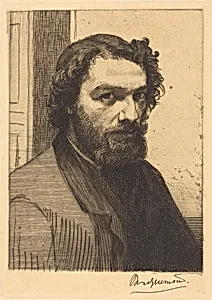
Medium
etching on laid paper
Dimensions
image: 14.7 × 10.9 cm (5 13/16 × 4 5/16 in.) plate: 16.6 × 11.7 cm (6 9/16 × 4 5/8 in.) sheet: 29.1 × 20.4 cm (11 7/16 × 8 1/16 in.)
Classification
Department
CG-E
Museum
National Gallery of Art, Washington, D.C.
Credit
Gift of George Matthew Adams in memory of his mother, Lydia Havens Adams
Accession Number
1946.4.12
Rights
Public Domain
Art Historical Context
In 1861, French etcher Félix Bracquem created this intimate portrait etching of his contemporary, Alphonse Legros, capturing the essence of a fellow artist during a pivotal moment in 19th-century printmaking Rendered on laid paper—a traditional support with visible chain lines that lent etchings a tactile, handmade quality—the image measures a modest 14.7 × 10.9 cm, ideal for private collectors and artist circles. Bracquemond, a master of the medium, helped revive etching in France as a fine art form, rivaling painting in expressive depth. Etching, an intaglio technique involving acid biting into a metal plate, allowed Bracquemond to achieve rich tonal contrasts and fine lines, hallmarks of the Realist movement then dominating French art. Legros, known for his own etchings and paintings, shared Bracquemond's passion for pushing printmaking boundaries, influenced by emerging Japanese aesthetics. This work exemplifies their camaraderie amid Paris's vibrant art scene, where prints became democratic alternatives to costly oils. Today, housed in the National Gallery of Art as a gift from George Matthew Adams, this etching invites visitors to appreciate the precision and personality of mid-century portraiture—a window into the lives of artists shaping modern visual culture.
About the Artist
Félix Bracquemond · 1833–1914
French, Paris 1833–1914 Sèvres