
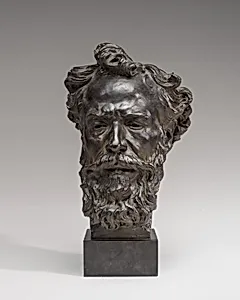
Alphonse Legros
model c. 1876, cast possibly 1879/1920
Medium
bronze
Dimensions
overall: 34.1 x 23.7 x 23.7 cm (13 7/16 x 9 5/16 x 9 5/16 in.)
Classification
Sculpture
Department
CSD
Museum
National Gallery of Art, Washington, D.C.
Credit
Gift of George Matthew Adams in memory of his mother, Lydia Havens Adams
Accession Number
1956.14.2
Rights
Public Domain
Art Historical Context
**Alphonse Legros** a compelling bronze sculpture by the French artist Aimé-Jules Dal, modeled around 1876 and possibly cast between 1879 and 1920. This intimate portrait captures Alphonse Legros, a fellow artist and close friend of Dalou—a French-born, etcher, and who became a prominent figure in London's art scene after emigrating in the 1870s. Dalou, known for his realistic depictions of everyday life and labor, here applies his masterful skill to honor a colleague, rendering Legros with lifelike detail in a bust format measuring 34.1 x 23.7 x 23.7 cm. Created during a period of artistic exile for Dalou following the Paris Commune, the work reflects the Realism movement's emphasis on truthful representation over idealization. In London, Dalou and Legros shared a vibrant intellectual circle, influencing each other's naturalistic styles. The bronze medium, with its enduring patina and ability to convey subtle textures like skin and hair, underscores Dalou's technical prowess in capturing human vitality. Today, this sculpture graces the National Gallery of Art, a gift from George Matthew Adams in memory of his mother, Lydia Havens Adams. It invites visitors to ponder the deep bonds of artistic camaraderie amid 19th-century upheaval, offering a tangible link to the era's creative spirit.