
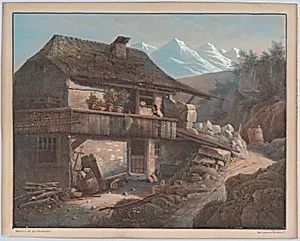
Alpine Scene
first half 19th century
Medium
Hand colored lithograph
Dimensions
Sheet: 7 3/4 in. × 10 in. (19.7 × 25.4 cm) Image: 7 1/8 × 9 3/8 in. (18.1 × 23.8 cm)
Classification
Prints
Department
Drawings and Prints
Museum
Metropolitan Museum of Art, New York, NY
Credit
Gift of Mrs. Edward C. Moën, 1961
Accession Number
61.687.17
Rights
Public Domain
Tags
Art Historical Context
"Alpine Scene" is a charming hand-colored lithograph created by Henri Boug dschwiller and printed by the esteemed Parisian firm Lemercier Bénard et Cie in the first half of the19th century. Measuring just 7 3/4 by 10 inches, this intimate print captures the majestic beauty of the Alps, featuring rugged mountains and quaint houses nestled in their shadows. Produced during the Romantic era, it reflects the period's fascination with nature's sublime power, evoking awe and tranquility for viewers. Lithography, a revolutionary technique invented around 1798, allowed for detailed reproductions from a single stone, making art more accessible. The hand-coloring adds a vibrant, painterly quality, with delicate washes bringing the snowy peaks and rustic dwellings to life— a labor-intensive process that elevated prints from mere copies to collectible artworks. Lemercier, Bénard et Cie. were leaders in this medium, known for high-quality illustrated books and scenic views popular among the growing middle class. Today, this piece resides in the Metropolitan Museum of Art's Drawings and Prints department, a gift from Mrs. Edward C. Moën in 1961. It offers a window into 19th-century travelogues and alpine tourism, reminding us how such scenes inspired wanderlust and appreciation for Europe's dramatic landscapes.
About the Artist
Henri Boug d'Orschwiller|Lemercier, Bénard et Cie. · 1783–1859
French, Colmar 1783–1859 Paris|French, Paris