
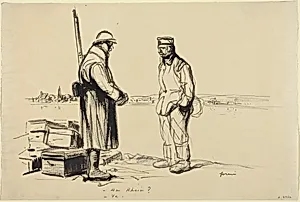
-Am Rhien? -Ya.
c. 1918
Medium
brush and black ink and black crayon on laid paper
Dimensions
overall: 31.5 x 47.4 cm (12 3/8 x 18 11/16 in.)
Classification
Drawing
Department
CG-E
Museum
National Gallery of Art, Washington, D.C.
Credit
Rosenwald Collection
Accession Number
1943.3.4089
Rights
Public Domain
Art Historical Context
Jean-Louis Forain's *–Am Rhien? –Ya.* (c. 1918) captures a moment of wartime tension through sparse yet expressive lines. Created as a drawing in brush and black ink with black crayon on laid paper31.5 x 47.4 cm), it exemplifies Forain's mastery of quick, gestural sketches. The French artist, known for his early Impressionist associations and later shift to incisive social commentary and caricature, often turned his keen eye to the human drama of World War I, producing poignant illustrations for French magazines and posters supporting the Allied cause. The enigmatic title—evoking a German exchange ("Am Rhein?" meaning "On the Rhine?" and "Ja," or "Yes")—hints at intercepted dialogue, perhaps among soldiers or prisoners, reflecting the era's front-line uncertainties as the war neared its end in 1918. Forain's technique, blending fluid ink washes with bold crayon accents, conveys immediacy and irony, a hallmark of his satirical style that critiqued authority while humanizing everyday struggles. Housed in the National Gallery of Art's Rosenwald Collection, this work underscores the drawing's role in 20th-century art as both personal record and cultural artifact, inviting viewers to ponder the fragile lines between enemy and everyman amid history's upheavals.
About the Artist
Jean-Louis Forain · 1852–1931
Jean-Louis Forain was born Louis Henri Forain on October 23, 1852, in Reims, France, to a family of modest means; his father painted ornamental signs. The family relocated to Paris when he was eight, where young Forain developed a passion for drawing inspired by the sculptures of Reims Cathedral and the masters at the Louvre, which he began copying at age fourteen. He received drawing lessons from...