
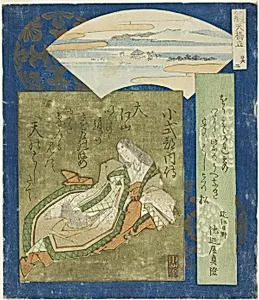
Amanohashidate: Koshikibu no Naishi, No. 2 from "Three Famous Scenes (Sankei no uchi: Sono ni)"
c. 1833
Medium
Color woodblock print; center sheet of shikishiban triptych (right: 1954.745, left: 1954.589), surimono
Dimensions
20.8 × 18 cm (8 1/4 × 7 1/8 in.)
Classification
woodblock print
Department
Arts of Asia
Museum
Art Institute of Chicago
Accession Number
81145
Rights
Public Domain
Art Historical Context
Discover the serene beauty of *Amanohashidate: Koshikibu no Naishi*, the central sheet of a shikishiban triptych by Totoya Hokkei, created around 1833. This exquisite color woodblock print captures Amanohashidate, one of Japan's "Three Famous Views" (Nihon Sankei), a pine-covered sandbar in Kyoto Prefecture poetically likened to a "bridge to heaven" when viewed upside down. Hokkei, a skilled ukiyo-e artist and pupil of the master Katsushika Hokusai, infuses the scene with delicate elegance, featuring the inscription of the court lady-poet Koshikibu no Naishi, evoking classical waka poetry traditions. As a surimono—a luxurious, privately commissioned print often produced for New Year's greetings or poetry gatherings—this work exemplifies Edo-period artistry. Surimono were printed on high-quality paper with vibrant colors, metallic pigments, and subtle embossing, reserved for elite patrons who appreciated their refined craftsmanship over mass-produced ukiyo-e. Hokkei's precise lines and atmospheric perspective highlight the misty sands and graceful pines, blending landscape mastery with literary homage in the "Three Famous Scenes" series. Housed in the Art Institute of Chicago's Arts of Asia collection, this 20.8 × 18 cm gem invites viewers to ponder Japan's enduring reverence for nature's wonders, where art, poetry, and seasonal beauty intertwine. A testament to Hokkei's legacy, it bridges the floating world of ukiyo-e with timeless cultural reverence.
About the Artist
Totoya Hokkei · 1780–1850
Totoya Hokkei (魚屋 北渓, 1780–1850), born Iwakubo Tatsuyuki in Edo (modern Tokyo), began his life as a humble fishmonger in the Yotsuya Samegahashi district, a trade reflected in his art name "Totoya," meaning fish shop. He transitioned to art through rigorous training, first studying under Kanō Yōsen'in Korenobu, head of the Kobikichō branch of the prestigious Kanō school, where he honed landscape p...