
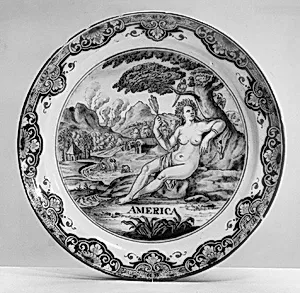
America (part of a set of four)
late 17th–early 18th century
Medium
Tin-glazed earthenware
Dimensions
1 1/16 × 8 3/4 in. (2.7 × 22.2 cm)
Classification
Ceramics-Pottery
Culture
German, Frankfurt
Department
European Sculpture and Decorative Arts
Museum
Metropolitan Museum of Art, New York, NY
Credit
Gift of Estate of James Hazen Hyde, 1959
Accession Number
59.208.33
Rights
Public Domain
Tags
Art Historical Context
Discover the enchanting *America*, a petite tin-glazed earthenware from late 17th- to early 18th-century, Germany. Crafted Cornelis van Daten the Younger Dirck Barendsz., this slender piece (just over 8 inches long and a mere 1 inch high) to a rare set of four, each symbolizing a continent in the Baroque tradition of allegorical art. Produced in Frankfurt's vibrant ceramics workshops, it exemplifies the city's mastery of tin-glazed earthenware—also known as faience—where a white tin oxide glaze provided a smooth canvas for vivid, durable polychrome decoration fired at high temperatures. Vibrant imagery evokes the New World's exotic allure: lush landscapes dotted with trees, fluttering birds, and graceful female nudes likely personifying America as a bountiful, untamed paradise. This motif reflected Europe's fascination with global exploration during the Age of Discovery, blending fantasy with emerging colonial narratives. Housed in The Metropolitan Museum of Art's European Sculpture and Decorative Arts collection (gift of the Estate of James Hazen Hyde, 1959), *America* highlights Frankfurt faience's role in affordable luxury for bourgeois homes. Its delicate scale suggests use as a wall tile or trinket, offering a window into 18th-century tastes for worldly symbolism in everyday elegance.
About the Artist
Cornelis van Daten the Younger|Dirck Barendsz. ( |Netherlandish) · 1638 |1534 –1664 |1592
1638–1664|Netherlandish, Amsterdam 1534–1592 Amsterdam