
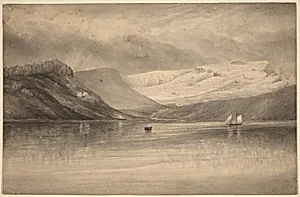
American Observing Station, Kerquelen Islands
1874/1875
Medium
pen and black ink with gray and black wash on wove paper
Dimensions
sheet: 18.5 × 28.3 cm (7 5/16 × 11 1/8 in.)
Classification
Drawing
Department
CG-W
Museum
National Gallery of Art, Washington, D.C.
Credit
John Davis Hatch Collection
Accession Number
1979.20.88
Rights
Public Domain
Art Historical Context
In the remote, windswept Kerguelen Islands of southern Indian Ocean—often called the "Desolation Islands"—John Moran captured a pivotal moment of 19th-century scientific exploration his 1874/1875 drawing *American Observing Station, Kerelen Islands*. Moran, a skilled American artist from a prominent family of painters including his brother Thomas Moran, served as the official artist on the USS *Swatara* during the U.S. Naval Observatory's expedition to witness the rare Transit of Venus. This astronomical event, visible only from specific global sites, was crucial for refining measurements of the solar system's scale, marking a high point of international scientific collaboration. Moran's on-site sketch depicts the modest American station amid the stark, sub-Antarctic landscape, highlighting humanity's bold push into uncharted territories. Rendered in pen and black ink with subtle gray and black washes on wove paper (18.5 × 28.3 cm), the work exemplifies rapid field documentation: precise ink lines define structures and tents, while washes evoke moody shadows and vast emptiness, blending journalistic accuracy with atmospheric drama. Housed in the National Gallery of Art's John Davis Hatch Collection, this drawing offers a window into an era when art and science intertwined, preserving the grit of exploration for posterity. It's a testament to Moran's versatility beyond grand landscapes, underscoring the cultural value of visual records in advancing human knowledge.
About the Artist
John Moran · 1821–1903
John Moran (1821–1903) was a British-born American landscape painter and photographer who became a significant figure in the artistic life of Philadelphia during the second half of the nineteenth century. Born in Bolton, Lancashire, England, he emigrated to the United States as a young man and settled in Philadelphia, where he became closely associated with one of the most remarkable artistic fami...