
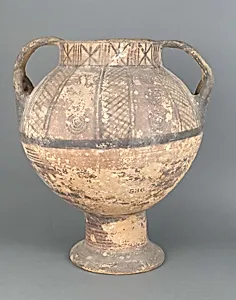
Amphora
Unknown Artist
750–600 BCE
Medium
Terracotta
Dimensions
13 13/16in. (35.1cm)
Classification
Vases
Culture & Period
Cypriot · Cypro-Archaic I
Department
Greek and Roman Art
Museum
Metropolitan Museum of Art, New York, NY
Credit
The Cesnola Collection, Purchased by subscription, 1874–76
Accession Number
74.51.774
Rights
Public Domain
Art Historical Context
This elegant terracotta amphora, to the Cypro-Archaic I period750–600 BCE),ails from ancient Cyprus—a vibrant crossroads of Mediterranean cultures blending Greek, Near Eastern, Egyptian influences. Standing at just over 13 inches tall, this two-handled vase exemplifies Cypriot pottery craftsmanship, likely used for storing olive oil, wine, or in daily life or trade. Its modest size suggests it was a practical household item, reflecting the island's role as a bustling port in the early Iron Age. Crafted from fired clay, the amphora showcases the period's wheel-thrown techniques, producing durable forms with a smooth, reddish surface. Cypro-Archaic vases like this often featured incised or painted motifs—geometric patterns or stylized figures—highlighting Cyprus's unique artistic fusion amid emerging Archaic styles. As part of the Metropolitan Museum of Art's Greek and Roman Art Department, it underscores the Cesnola Collection's pioneering acquisition in 1874–76, one of the earliest major assemblages of Cypriot antiquities in the West. Today, this unadorned yet evocative vessel invites us to ponder the anonymous potter's skill and the lives it touched, bridging us to Cyprus's dynamic ancient world.