
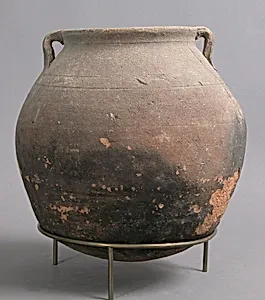
Amphora
Unknown Artist
4th–7th century
Medium
Earthenware
Dimensions
Overall: 8 5/8 x 8 7/16 in. (21.9 x 21.4 cm)
Classification
Ceramics
Culture
Coptic
Department
Medieval Art
Museum
Metropolitan Museum of Art, New York, NY
Credit
Rogers Fund, 1925
Accession Number
25.10.20.117
Rights
Public Domain
Art Historical Context
This modest yet evocative amphora, crafted by an unknown Coptic artisan between the 4th and 7th centuries, offers a window into everyday life in early Christian Egypt Standing just over 8 inches tall, this earthenware vessel exemplifies the practical ceramics produced in the Nile Valley during Late Antiquity, a time when Coptic culture blended ancient Egyptian traditions with emerging Christian influences. Amphorae like this were essential for storing and transporting goods such as olive oil, wine, or, reflecting the region's vibrant trade networks and agricultural economy. Made from earthenware—a low-fired clay that was durable yet accessible—this piece highlights the Coptic mastery of simple, functional pottery techniques. Without elaborate glazing or decoration (as is typical of many surviving examples), its bulbous form and sturdy handles prioritize utility over ornamentation, underscoring the Copts' adaptation of Roman and Greco-Egyptian vessel shapes to local needs. Acquired through the Rogers Fund in 1925, it now resides in the Metropolitan Museum of Art's Medieval Art department, reminding us how humble objects illuminate the daily rhythms of a transformative era. Though unadorned, this amphora speaks volumes about resilience and continuity, bridging pagan antiquity and the dawn of medieval Christianity in Egypt.