
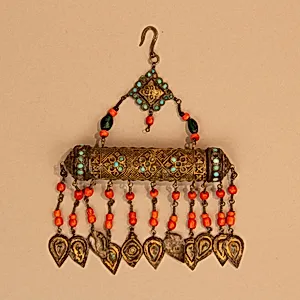
Amulet Case, One of a Pair
Unknown Artist
19th century
Medium
Silver, coral, turquoise, glass
Classification
Jewelry
Department
Islamic Art
Museum
Metropolitan Museum of Art, New York, NY
Credit
Edward C. Moore Collection, Bequest of Edward C. Moore, 1891
Accession Number
91.1.1147
Rights
Public Domain
Art Historical Context
This exquisite *Amulet Case, One a Pair*, crafted in the 19th century an unknown artist, exemplifies the intricate jewelry traditions of Islamic art. Fashioned from silver, coral, turquoise, and glass, served as a protective pendant, likely designed to house small scrolls with Quranic verses or prayers Such cases were worn close to the body—around the neck or wrist—to ward off evil spirits, the evil eye, misfortune, reflecting deep cultural beliefs in spiritual safeguarding. The materials chosen carry symbolic weight: silver for purity, vibrant coral and turquoise for their apotropaic (protective) properties revered across Islamic regions from the Ottoman Empire to Persia, and glass for colorful beads or inlays that added visual allure. The craftsmanship highlights skilled metalworking techniques, with filigree or granulation typical of the era, blending functionality with ornamental beauty. Part of the Edward C. Moore Collection bequeathed to the Metropolitan Museum of Art in 1891, this piece offers a window into everyday devotional life in the 19th-century Islamic world, where personal adornment intertwined art, faith, and folklore. Its survival as one of a pair underscores the value placed on such talismans in pairs for enhanced potency.