
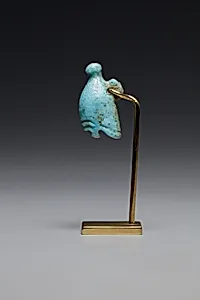
Amulet: Crown of Upper Egypt
Unknown Artist
664–332 B.C.
Medium
Faience
Dimensions
H. 2.2 × W. 0.9 × D. 1.3 cm (7/8 × 3/8 × 1/2 in.)
Classification
Amulet, crown, Upper Egypt
Period
Late Period
Department
Egyptian Art
Museum
Metropolitan Museum of Art, New York, NY
Credit
Gift of Columbia University, 1924
Accession Number
24.4.4
Rights
Public Domain
Art Historical Context
Nestled in the Egyptian Art collection at the Metropolitan Museum of Art, this faience amulet, titled *Crown of Upper Egypt*, dates to Egypt's Late Period (664332 B.C.). Measuring just 2.2 cm high, it depicts the iconic white crown, or *hedjet*, symbol the power and sovereignty of Upper Egypt southern Nile region. Crafted by an unknown artist, this tiny talisman was likely worn as jewelry or placed in tombs, embodying the protective magic central to ancient Egyptian life. Faience, a composite of quartz, lime, and clay, was prized for its vibrant turquoise hue, evoking the eternal Nile and rebirth. Fired at high temperatures, it created a glassy sheen that mimicked precious stones like lapis lazuli, making durable, affordable amulets accessible beyond elites. During the Late Period—a time of foreign influences yet enduring pharaonic traditions—this crown form invoked divine kingship, warding off evil and ensuring prosperity. Gifted to the Met by Columbia University in 1924, this artifact offers a glimpse into everyday spirituality, where even small objects bridged the mortal and divine worlds. Visitors, imagine slipping it into your palm— a portal to ancient rituals of protection and power.