
Amulet depicting a ram-headed god
Unknown Artist
664–332 B.C.
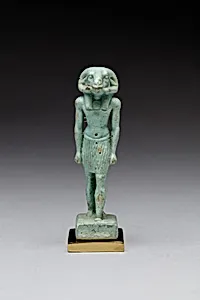
Medium
Faience
Dimensions
H. 5.1 × W. 1.2 × D. 1.6 cm (2 × 1/2 × 5/8 in.)
Classification
Amulet, god, ram-headed
Period
Late Period
Department
Egyptian Art
Museum
Metropolitan Museum of Art, New York, NY
Credit
Purchase, Edward S. Harkness Gift, 1926
Accession Number
26.7.891
Rights
Public Domain
Art Historical Context
This delicate faience amulet, crafted during Egypt's Late Period (664–332 B.C.), depicts a ram-headed god, a potent symbol of divine power and fertility. Standing just 5.1 cm tall, it exemplifies the intricate small-scale sculptures produced for personal devotion. Faience, a glazed composite of quartz, lime, and copper for its signature vibrant blue-green hue, was prized in ancient Egypt for mimicking precious stones like turquoise or lapis lazuli while being more accessible. This medium's glassy surface not only enhanced durability but also evoked the eternal Nile waters, aligning with themes of rebirth and protection. Amulets like this were worn or carried as talismans, believed to harness the god's protective magic—likely Khnum, the ram-headed creator deity who molded humans on his potter's wheel, or a form of Amun. Produced in the Late Period, amid political fragmentation and Persian influences, such objects reflect a surge in personal piety and affordable religious art for everyday Egyptians. Today, at the Metropolitan Museum of Art (purchased via the Edward S. Harkness Gift in 1926), this amulet offers a window into ancient beliefs in divine intervention, showcasing masterful mold-making and glazing techniques that have preserved its luster for millennia.