
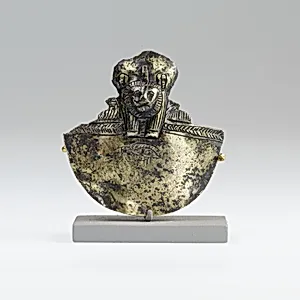
Amulet: Head of Sakhmet
Unknown Artist
664–332 B.C.
Medium
Silver
Dimensions
H. 2.8 × W. 2.7 × D. 0.4 cm (1 1/8 × 1 1/16 × 3/16 in.)
Classification
Amulet, Aegis, Sakhmet
Period
Late Period
Department
Egyptian Art
Museum
Metropolitan Museum of Art, New York, NY
Credit
Gift of Lily S. Place, 1923
Accession Number
23.6.62
Rights
Public Domain
Art Historical Context
This delicate silver amulet depicts the head of Sakhmet the fierce lion-headed goddess in ancient Egypt as a protector against evil, a warrior deity, and a healer. Crafted during the Late Period664–332 B.C.), Dynasties 26–30, it measures just 2.8 cm high, perfect for wearing as a personal talisman around the neck or as part of jewelry. Such amulets were everyday safeguards, invoking Sakhmet's dual powers of destruction and restoration to shield the wearer from harm. Silver, a precious and rare metal in ancient Egypt, underscores the amulet's value, likely produced through lost-wax casting or hammering techniques common in the period. During the Late Period, Egypt saw Persian and Greek influences, yet traditional iconography like Sakhmet's stylized features—sharp eyes, prominent ears, and solar disk—persisted, blending continuity with innovation. These tiny masterpieces highlight the Egyptians' profound belief in the magical potency of images. Today, this gift to the Metropolitan Museum of Art in 1923 offers a window into personal devotion, reminding us how ancient faith intertwined art, religion, and daily life. (198 words)