
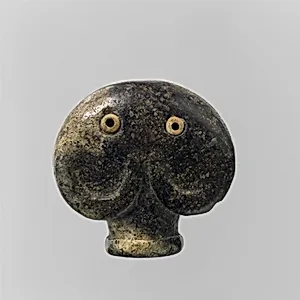
Amulet in the form of a head of an elephant
Unknown Artist
ca. 3500–3300 B.C.
Medium
Serpentinite, bone
Dimensions
h. 3.5 x w. 3.6 x d. 2.1 cm (1 3/8 x 1 7/16 x 13/16 in.)
Classification
Amulet, elephant
Period
Predynastic, Naqada II
Department
Egyptian Art
Museum
Metropolitan Museum of Art, New York, NY
Credit
Rogers Fund, 1959
Accession Number
59.101.1
Rights
Public Domain
Tags
Art Historical Context
This delicate amulet, carved in the form of an elephant's head, dates to Egypt's Predynastic Naqada II period (. 3500–3300 B.C.), a time of remarkable cultural flourishing just before the unification of Upper and Lower Egypt. Crafted from serpentinite—a, green stone prized for its workability—and inlaid with bone for the eyes and tusks, it measures a mere 3.5 cm high, suggesting it was worn as a protective pendant on a necklace or bracelet. Such small-scale carvings highlight the era's sophisticated lapidary skills, where artisans transformed hard stones into intricate forms using simple tools like copper drills and abrasives. Elephants held powerful symbolic meaning in ancient Egypt, evoking strength, exotic trade networks (via ivory imports from Nubia), and perhaps fertility or protection against evil. Amulets like this were ubiquitous in Naqada II burials, believed to safeguard the wearer in life and the afterlife. The naturalistic rendering of the elephant's trunk, ears, and fierce gaze reflects early Egyptian mastery of animal motifs, foreshadowing the iconic iconography of later dynasties. Today, this rare piece from the Metropolitan Museum of Art's Egyptian collection offers a glimpse into predynastic spirituality and artistry, reminding us how everyday objects carried profound cultural weight.