
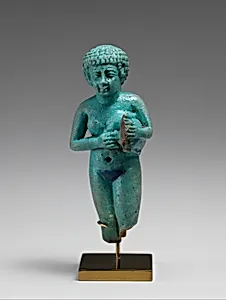
Amulet: Woman Playing Lyre
Unknown Artist
664–332 B.C.
Medium
Light blue faience
Dimensions
H. 5.4 × W. 2.1 × D.1.9 cm (2 1/8 × 13/16 × 3/4 in.)
Classification
Statuette, woman, lyre
Period
Late Period
Department
Egyptian Art
Museum
Metropolitan Museum of Art, New York, NY
Credit
Gift of J. Pierpont Morgan, 1917
Accession Number
17.194.2441
Rights
Public Domain
Tags
Art Historical Context
This delicate faience amulet, *Woman Playing Lyre*, hails from Egypt's Late Period (664– B.C.), specifically Dynasties 26–30. Carved in vibrant light blue glaze, it measures just 5.4 cm high, making it a perfect personal talisman worn for protection or good fortune. The nude female figure strums a lyre—a stringed instrument symbolizing music's sacred role in ancient Egyptian rituals, celebrations, and afterlife beliefs—capturing a moment of graceful harmony. Faience a molded ceramic coated in glossy silica glaze, was prized for its jewel-like sheen, mimicking precious stones like lapis lazuli and evoking the Nile's life-giving waters. This technique allowed mass production of affordable amulets during a time of cultural revival amid foreign influences, blending traditional motifs with everyday devotion. Such objects safeguarded wearers against evil, promoted fertility, or invoked divine favor through music's enchanting power. Today, this gift from J. Pierpont Morgan resides in the Metropolitan Museum of Art's Egyptian Art department, offering a window into how ordinary Egyptians infused daily life with artistry and mysticism. A tiny testament to music's timeless allure!