
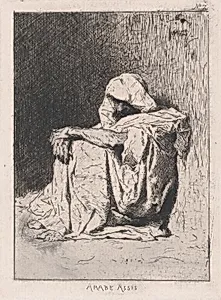
An Arabic man seated on the ground, head partly covered
1860–62
Medium
Etching
Dimensions
Sheet: 18 7/8 × 13 3/4 in. (48 × 35 cm) Plate: 5 1/2 × 4 1/16 in. (14 × 10.3 cm)
Classification
Prints
Department
Drawings and Prints
Museum
Metropolitan Museum of Art, New York, NY
Credit
Gift of M. Knoedler & Co
Accession Number
19.18.6
Rights
Public Domain
Tags
Art Historical Context
Mariano Fortuny’s etching *An Arabic Man Seated on the Ground, Head Partly Covered* captures a quiet moment of repose from the artist’s travels in North Africa. Created between 1860 and 1862, during Fortuny’s formative visit to Morocco, the print reflects the Spanish painter’s deep fascination with everyday life in the region. Though best known for his luminous oil paintings, Fortuny turned to etching to record the textures of clothing, posture, and light he encountered there, producing intimate studies that later informed his larger canvases. Executed on a small copper plate measuring just over five inches, the etching demonstrates Fortuny’s remarkable command of line. Delicate cross-hatching and varied pressure create a sense of volume and fabric folds with remarkable economy, inviting viewers to appreciate the artist’s technical precision. The modest scale encourages close looking, a quality that made etchings popular among 19th-century collectors seeking portable works of art. Today the print resides in the Metropolitan Museum’s collection as part of its holdings in drawings and prints. It offers a window into the Orientalist interests of European artists at mid-century while showcasing Fortuny’s ability to distill observed reality into elegant, economical form.
About the Artist
Mariano Fortuny, 1838–1874 (Spanish) · 1838 –1874
Spanish, 1838–1874