
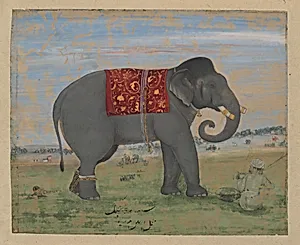
An Elephant and Keeper
Unknown Artist
ca. 1650–60
Medium
Opaque color and gold on paper
Dimensions
Image: 7 1/16 × 8 11/16 in. (18 × 22 cm) Frame: 11 1/2 × 13 1/4 × 3/4 in. (29.2 × 33.7 × 1.9 cm)
Classification
Codices
Department
Islamic Art
Museum
Metropolitan Museum of Art, New York, NY
Credit
Howard Hodgkin Collection, Purchase, Florence and Herbert Irving Acquisitions, Harris Brisbane Dick, and 2020 Benefit Funds; Howard S. and Nancy Marks, Lila Acheson Wallace, and Friends of Islamic Art Gifts; Louis V. Bell, Harris Brisbane Dick, Fletcher, and Rogers Funds and Joseph Pulitzer Bequest; and funds from various donors, 2022
Accession Number
2022.187
Rights
Public Domain
Tags
Art Historical Context
In the heart of 17th-century Islamic art *An Elephant and Keeper* (ca. 1650–60) captiv with its delicate portrayal of a majestic elephant guided by its handler. Created by an unknown artist using opaque colors and gold on paper—a hallmark of Persianate and Mughal miniature traditions—this 7 1/16 × 8 11/16 in. image likely originates from a codex, or illustrated manuscript album, blending narrative illustration with exquisite craftsmanship. Elephants held profound cultural symbolism in Islamic South Asia, especially during the Mughal Empire, representing royal power, strength, and spectacle in courtly processions or hunts. This artwork, housed in the Metropolitan Museum of Art's Islamic Art Department, exemplifies how beasts were depicted with lifelike detail and vibrant hues, their massive forms softened by intricate gold accents that catch the light like jewels. The use of opaque pigments allowed for bold, saturated colors and fine lines, techniques perfected in workshops where artists captured fleeting moments of harmony between human and animal. As part of the Howard Hodgkin Collection, this piece invites visitors to marvel at the anonymous genius behind Mughal-era miniatures, bridging art, history, and the awe-inspiring animal world.