
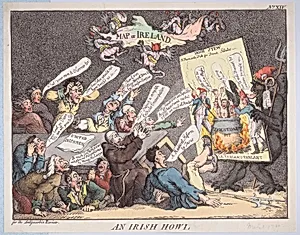
An Irish Howl
March 1, 1799
Medium
Hand-colored etching; reduced copy
Dimensions
Sheet: 6 7/8 × 8 11/16 in. (17.5 × 22.1 cm)
Classification
Prints
Department
Drawings and Prints
Museum
Metropolitan Museum of Art, New York, NY
Credit
The Elisha Whittelsey Collection, The Elisha Whittelsey Fund, 1959
Accession Number
59.533.1954
Rights
Public Domain
Tags
Art Historical Context
Thomas Rowlandson's *An Irish Howl* (March 1, 1799) is a spirited hand-colored etching, a copy measuring just 6 7/8 × 8 11/16 inches. As a master of British caricature, Rowlandson delighted audiences with his witty, exaggerated prints that skewered the social and political follies of his time. This work exemplifies his satirical style, blending sharp line work with vibrant hand-coloring—a technique that brought his scenes to vivid, humorous life, making them affordable and popular among 18th-century print buyers. Created amid turbulent times, including the aftermath of the 1798 Irish Rebellion and debates over the Act of Union, the etching likely lampoons political figures or events through devilish imagery and howling Irish motifs, as suggested by its tags of satire, politics, devil, and men. Rowlandson's irreverent humor often featured grotesque characters and infernal elements to mock authority, reflecting Britain's complex relationship with Ireland. Housed in the Metropolitan Museum of Art's Elisha Whittelsey Collection, this print highlights the cultural power of caricature in Georgian England, where art served as a democratized form of protest and entertainment. Visitors will appreciate its cheeky bite, a window into how Rowlandson captured the era's anxieties with a devil-may-care flair.
About the Artist
Thomas Rowlandson · 1756–1827
Thomas Rowlandson (1757–1827) was an English artist and caricaturist whose satirical watercolors and prints captured the social life of Georgian Britain with unparalleled wit and technical mastery. Alongside James Gillray, he is recognized as one of the greatest British graphic artists, and his distinctive flowing line and keen observations have made his work integral to understanding late 18th an...