
Anamese, Cochinchina; Solomon; Dyak Skull
1865
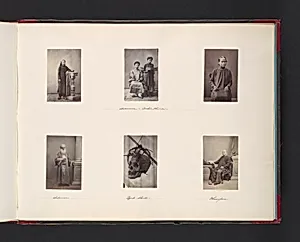
Medium
Albumen silver print from glass negative
Dimensions
Approx. 9.2 × 6.2 cm (3 5/8 × 2 7/16 in.); each
Classification
Photographs
Department
Photographs
Museum
Metropolitan Museum of Art, New York, NY
Credit
Gilman Collection, Purchase, Cynthia Hazen Polsky Gift, 2005
Accession Number
2005.100.583 (135a–f)
Rights
Public Domain
Art Historical Context
John Thomson's *Anamese, Cochinchina; Solomon; Dyak* (1865) is a captivating albumen silver print from glass negative, measuring just 9.2 × 6.2 cm. Captured during Thomson's extensive travels through Southeast Asia in the mid-19th, this intimate photograph likely documents ethnographic subjects from diverse regions: the Anamese people of Cochinchina (southern), a figure from the Solomon Islands, a Dyak (Dayak) skull from Borneo. As one of the era's pioneering photographers, Thomson brought a keen eye to the cultures of colonial Asia, blending portraiture with anthropological curiosity. The albumen process, popular in the 1850s–1890s, produced richly toned images with fine detail, making it ideal for such small, portable prints. These were often collected in albums by travelers and scholars, preserving visual records of distant peoples amid European expansion. Thomson's work exemplifies early documentary photography, bridging art and science by immortalizing customs like Dayak headhunting traditions, where skulls held ritual significance. Today, housed in the Metropolitan Museum of Art's Gilman Collection, this piece invites reflection on 19th-century encounters between East and West, highlighting photography's power to both humanize and exoticize the "other." A window into a vanishing world, it reminds us of the medium's enduring role in cultural preservation.
About the Artist
John Thomson · 1837–1921
John Thomson (1837–1921), a pioneering Scottish photographer, was born on 14 June 1837 in Edinburgh as the eighth of nine children to William Thomson, a tobacco spinner and trader, and Isabella Newlands.) After schooling in the early 1850s, he apprenticed with a local optical and scientific instrument manufacturer, where he mastered the principles of photography, completing his training around 185...