
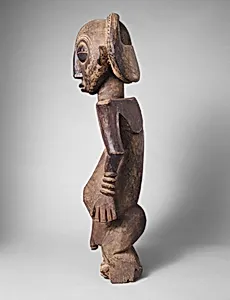
Ancestor Figure: Male
Unknown Artist
18th–19th century
Medium
Wood, kaolin
Dimensions
H. 30 1/2 × W. 11 3/8 × D. 7 1/2 in. (77.5 × 28.9 × 19.1 cm)
Classification
Wood-Sculpture
Culture
Boyo peoples
Department
Arts of Africa, Oceania, and the Americas
Museum
Metropolitan Museum of Art, New York, NY
Credit
The Michael C. Rockefeller Memorial Collection, Gift of Nelson A. Rockefeller, 1964
Accession Number
1978.412.424
Rights
Public Domain
Tags
Art Historical Context
This striking *Ancestor Figure: Male*, carved by an unknown artist of the Boyo peoples in the Democratic Republic of the Congo during the 18th–19th century, stands as a powerful testament to ancestral veneration in Central African traditions. Crafted from wood and coated with kaolin—a white clay prized for its ritual purity—the measures about 30 inches tall, embodying a stylized male form with elongated proportions typical of Boyo artistry. The kaolin encrustation not only protects the wood but also symbolizes spiritual essence, enhancing the figure's sacred aura during ceremonies. For the Boyo, such minga figures served as vital intermediaries between the living and the ancestral realm. Placed in shrines or family compounds, they honored deceased male elders, invoking their guidance, protection, and fertility blessings. This piece reflects the Boyo's sophisticated wood-carving techniques, where artisans balanced realism in facial features with abstracted limbs to convey authority and otherworldliness, underscoring the culture's deep-rooted beliefs in lineage and continuity. Now part of The Michael C. Rockefeller Memorial Collection at The Metropolitan Museum of Art—generously gifted by Nelson A. Rockefeller in 1964—this figure invites visitors to ponder the timeless role of art in preserving communal memory across continents and centuries.