
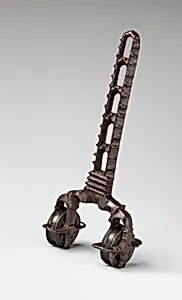
Anchor Plate from a Rope-and-Pulley System to Span a Crossbow
Unknown Artist
ca. 1475–1525
Medium
Steel, copper alloy
Dimensions
L. 7 in. (17.7 cm); W. 3 in. (7.7 cm); Wt. 8 oz. (224 g)
Classification
Archery Equipment
Culture
European, possibly British
Department
Arms and Armor
Museum
Metropolitan Museum of Art, New York, NY
Credit
Gift of William H. Riggs, 1913
Accession Number
14.25.1611
Rights
Public Domain
Art Historical Context
This unassuming yet ingenious anchor plate, dating to around 1475–1525, formed a crucial part of a rope-and-pulley system to span—or cock—a powerful crossbow. In late medieval Europe, possibly Britain, crossbows were fearsome battlefield weapons, prized for their penetrating power against armored knights. Spanning the heavy prod (bow) required immense strength, so devices like this multiplied the user's leverage, allowing even moderately skilled soldiers to ready shots quickly during the turbulent Wars of the Roses or early Tudor conflicts. Crafted from durable steel with copper alloy accents, the plate measures just 7 inches long and weighs a mere 8 ounces, showcasing the era's masterful metallurgy and precision forging. The copper alloy likely provided corrosion resistance and subtle decoration, blending raw functionality with the aesthetic refinement typical of high-quality arms and armor. Such equipment highlights the technological arms race of the time, where innovation in archery tools influenced warfare tactics across Europe. A gift to the Metropolitan Museum of Art from William H. Riggs in 1913, this artifact offers a tangible glimpse into the gritty ingenuity of medieval combat, reminding us how everyday components powered history's deadliest duels.