
Anchor Plate from the Pullman-Jennings Building, Chicago, Illinois
1882-83 (demolished 1978)
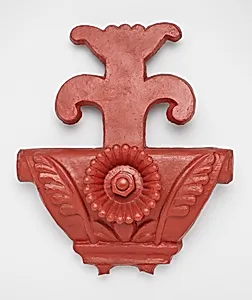
Medium
Painted cast iron
Dimensions
58 × 45 × 11 cm (22 7/8 × 17 3/4 × 4 3/8 in.)
Classification
architectural fragment
Department
Architecture and Design
Museum
Art Institute of Chicago
Accession Number
110546
Rights
Public Domain
Art Historical Context
This painted cast iron anchor plate once formed part of the structural and decorative framework of Chicago’s Pullman-Jennings Building, designed by architect Solon Spencer Bemen between 1882 and 1883. Anchor plates like this one helped tie together masonry walls while also serving as visible ornaments on the building’s exterior. Though the structure itself was demolished in 1978, the fragment survives as a tangible reminder of late-nineteenth-century Chicago architecture, when rapid urban growth encouraged inventive combinations of engineering and ornament. Cast iron was prized during this period for its strength, affordability, and ability to be molded into intricate patterns before being painted to resemble stone or other materials. Here, the plate’s bold geometric design and crisp detailing reflect the era’s interest in expressing industrial processes through architectural detail. Its modest dimensions belie its important role in both supporting the building and contributing to its public face. Preserved today in the Art Institute of Chicago’s Department of Architecture and Design, the piece offers visitors a direct connection to a vanished chapter of the city’s built environment. It illustrates how even functional components could carry artistic intent, bridging the worlds of engineering and design during Chicago’s formative decades.