
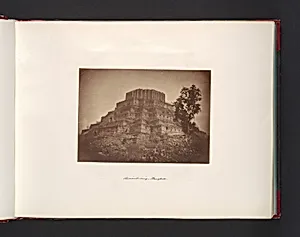
Ancient Ruins, Bangkok
1865
Medium
Albumen silver print from glass negative
Dimensions
16 × 22.6 cm (6 5/16 × 8 7/8 in.)
Classification
Photographs
Department
Photographs
Museum
Metropolitan Museum of Art, New York, NY
Credit
Gilman Collection, Purchase, Cynthia Hazen Polsky Gift, 2005
Accession Number
2005.100.583 (22a)
Rights
Public Domain
Art Historical Context
Step into the humid haze of 1865 Bangkok with John Thomson's *Ancient Ruins, Bangkok*, captivating albumen silver print freezes a moment of Thailand's layered history. Scottish photographer and explorer Thomson (18371921), renowned for his pioneering travels across Asia, ventured into Siam (modern-day Thailand) during a time of royal transformation under King Rama IV. This 16 × 22.6 cm photograph likely weathered Khmer-influenced amid the city's emerging modernity, offering visitors a rare Western glimpse into Southeast Asia's ancient past just as global trade routes were reshaping the region. Crafted from a glass negative, the albumen process—using egg whites to coat paper with light-sensitive silver salts—delivers Thomson's signature crisp details and warm tones, hallmarks of mid-19th-century photography. This technique, dominant from the 1850s to 1890s, allowed for richly textured prints that rivaled paintings in their evocative power, making distant locales accessible to armchair adventurers back in Europe. Housed in The Metropolitan Museum of Art's Gilman Collection, this work underscores photography's role as a bridge between cultures, preserving ephemeral ruins while highlighting Thailand's enduring architectural legacy. A testament to Thomson's adventurous spirit, it invites us to ponder the whispers of history echoing through Bangkok's vibrant streets.
About the Artist
John Thomson · 1837–1921
John Thomson (1837–1921), a pioneering Scottish photographer, was born on 14 June 1837 in Edinburgh as the eighth of nine children to William Thomson, a tobacco spinner and trader, and Isabella Newlands.) After schooling in the early 1850s, he apprenticed with a local optical and scientific instrument manufacturer, where he mastered the principles of photography, completing his training around 185...